

I've come to the South Island of New Zealand with Škoda to drive the Škoda Kodiaq RS and the Škoda Enyaq RS. No family in the back, no prams in the boot, not a single shopping bag in sight. Today this mum is having fun.
Škoda set us a question for the day: how does fast feel? These are the RS models, we're driving them on ice and snow, and I'm here to find out.
This isn't my full BabyDrive testing. I'll be putting both cars through that with my family in a few weeks, prams and shopping bags and all. But I had a day with them on a frozen skid pan under the Southern Alps, so here's what I already know about how they work for families, and what they're like when you throw them sideways.
Quick Links
- What is Škoda's Motion on Ice?
- How does the Škoda Kodiaq work for families?
- What is the Škoda Kodiaq RS like on ice?
- How does the Škoda Enyaq work for families?
- What is the Škoda Enyaq RS like on ice?
- The timed run
- So, how does fast feel?
What is Škoda's Motion on Ice?
Two cars, one sheet of ice, and a day spent learning to slide on purpose.
The Škoda Kodiaq is the seven-seat petrol SUV that most Australian families will recognise. The Enyaq is the five-seat electric one, sold as an SUV and as a Coupé. The RS badge is Škoda's performance line, and both cars wear it.

Both were fitted with winter tyres for grip on the ice, and we switched both into ESC Sport and Sport drive mode. The aim was to play with understeer and oversteer, which is a polite way of saying we spent the day making the back end step out on purpose. Škoda called it Motion on Ice. It was closer to ballet!

The dash read minus 1.5 degrees and that was once the sun was up. The cars were dancing and sliding all over the place.

How does the Škoda Kodiaq work for families?
The Kodiaq is Škoda's best-selling model, and the brand says SUVs make up 77% of its sales, so there's a decent chance you've been cross-shopping one.
In the second row it has ISOFix in the two outer seats and top tether anchorages on the back of all three seats. I've fitted three child seats across the second row of a Kodiaq before, in my 2020 Škoda Kodiaq Sportline review. It's a snug fit, so if you have wide child seats, check yours fit before you buy them.
With a rear-facing child seat installed behind, a 180cm driver still fits in front, which is good legroom, and there's room for lanky teenagers as they get older. If you're cross-shopping on that alone, here's my guide to which seven-seat SUVs will hold three child seats.

The third row is where families need to pay attention. There are no ISOFIX points and no top tether anchorages back there, so you can't install a child seat in either of those two seats. ANCAP says the same thing in its own report: installation of child restraints in the third row is not recommended. Those back two seats are for older kids and adults.
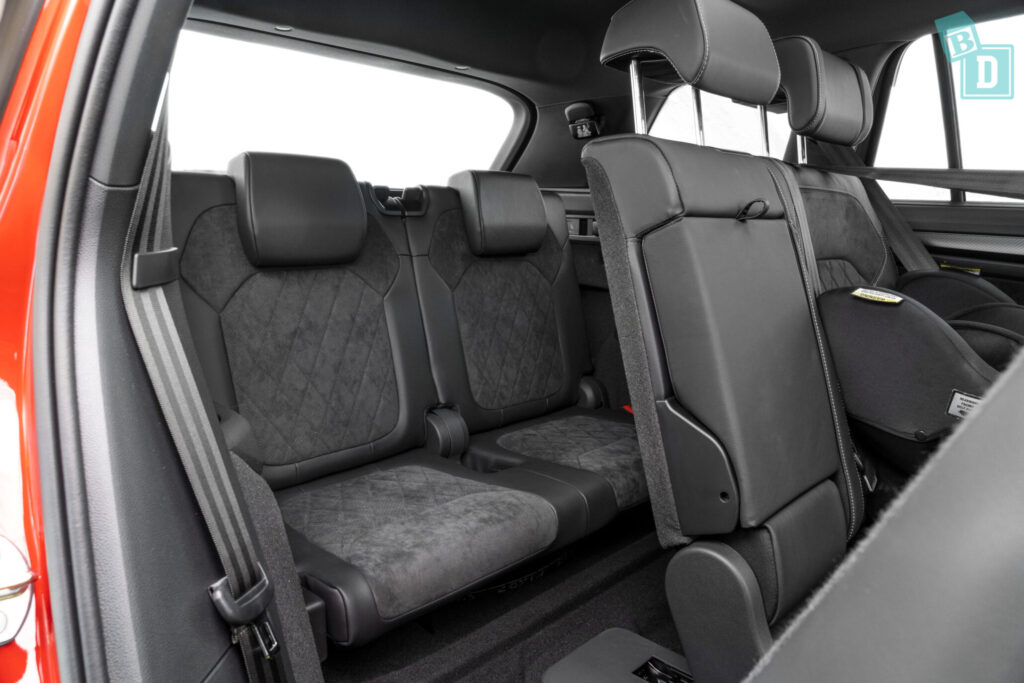
One of the things I love about Škodas for family life is all the little features. There are door edge protectors that flip out when you open the door, so if your kids fling it into the car next to you, nothing gets damaged, and you can replace the rubber if they do. There are built-in blinds in the rear windows.

There are tablet holders on the back of the front headrests so your little ones can watch something on the drive. And there are umbrellas tucked into the front doors.

The RS adds tri-zone climate control and heated outer rear seats, which the kids will thank you for on a winter school run.

The boot door opens and closes at the touch of a button and does it silently, which is fantastic if you've got a sleeping baby in the back. It has Škoda's Virtual Pedal too, so a wave of your foot opens it when both arms are full of kids and bags. There's storage under the boot floor for the retractable cargo blind, so it's not taking up room when you're loading prams. I'll be counting shopping bags in there with five seats and with seven seats when I have the car with my family.
The Kodiaq has a five-star ANCAP safety rating from 2024, scoring 87% for child occupant protection and 89% for adult occupant protection. It comes with nine airbags as standard, including a centre airbag between the front seats and curtain airbags covering both the front and second-row of the cabin. The airbags do not extend to the third-row seats. Škoda backs it with a seven-year, unlimited-kilometre warranty.
What is the Škoda Kodiaq RS like on ice?
The Škoda Kodiaq RS runs a 2.0-litre turbocharged petrol engine making 195kW and 400Nm through a seven-speed automatic gearbox, and it'll do 0 to 100km/h in 6.3 seconds. It lists at $70,590 before on-road costs.

After first driving the silent Enyaq, the noise was the first thing that told us we'd swapped cars. The engines sounded good, and I was keen to have a go.
You can feel the response through the pedals in a way the electric car doesn't give you. Throwing the back end out, it slides nicely. As I said at the time, JLo's got nothing on the back end of this car!
We took the Škoda Kodiaq RS through the slalom, weaving around the cones, playing with the oversteer and understeer, and my smile got wider and my giggles louder with every run. Then driving back to the start on the flat ice, you can feel the grip from those winter tyres. It felt planted and sure of itself, which is worth knowing if your family drives to the snow.

At one point I did start wondering whether this might be a better way to handle all the extra curricular drop off's and the drive-through on the way home from school pick-up, sliding sideways to the window to order two Happy Meals and a cup of tea for me! Then the rally drop-off: soccer, dance, swimming, one kid at each!
How does the Škoda Enyaq work for families?
The Enyaq is Škoda's five-seat electric SUV, and it also comes in a Coupé body. Both were on the ice with us.

The Škoda Enyaq RS gets an 82kWh battery (77kWh of that usable), all-wheel drive, 250kW and 545Nm, and 0 to 100km/h in 5.4 seconds. The updated model-year 2027 cars we drove are quoted at a combined WLTP range of 546km for the SUV and 557km for the Coupé, with city figures of 668km and 679km. That's plenty for a week of commutes, school runs and extracurricular drop-offs. It charges at up to 165kW on DC, which Škoda says takes it from 10 to 80% in about 29 minutes. The SUV lists at $76,590 and the Coupé at $77,590, before on-road costs. If you're weighing up going electric for the first time, I've written up 10 reasons electric and hybrid cars work well for families.

I haven't fitted child seats in an Enyaq yet, so stay tuned for that coming in a few weeks. What I can tell you now is that there's ISOFix in the two outer rear seats, and top tether anchorages for all three rear seats, with the centre one sitting behind the middle headrest.
Worth knowing if you're reading this from New Zealand: ANCAP notes that New Zealand Enyaqs don't get that centre top tether, so child restraints aren't recommended in the middle seat there. Australian cars do get it. A lower ISOFix anchorage and top tether anchorage suitable for the installation of forward-facing child restraints is fitted to the front passenger seat of New Zealand vehicles. Rearward facing child restraints however must not be installed in the front passenger seating position.
The Enyaq carries the same Škoda family features. It has built-in blinds in the rear windows, which we hardly ever see in a five-seat SUV these are fantastic for keeping the sun off little ones in the back. There are now two umbrellas in the front doors instead of one, three-zone climate control and a removable centre storage caddy with cupholders.

The boot door opens and closes silently at the touch of a button, and Virtual Pedal means you can open it with your foot when your hands are full of kids and their things. It doesn't beep either, so it won't wake your little ones asleep in the back. There's a small amount of storage under the boot floor for the cables and a couple of other bits. I will test the bootspace with prams, shopping bags and dogs in a few weeks.

On safety, the Enyaq has a five-star ANCAP rating from 2021, scoring 89% for child occupant protection and 94% for adult occupant protection. Škoda lists driver, passenger and centre airbags, plus side airbags for both rows and curtain airbags covering the front and rear seats. The centre airbag is the one that stops the two front occupants hitting each other in a side impact.
What is the Škoda Enyaq RS like on ice?
This was my first time driving an Enyaq, so I was keen to see what it did, and driving an EV on ice and snow is a useful way to find out how a battery copes with the cold.
We started with oversteer in the Enyaq. The power is instant, which makes the back end easy to bring around and, at first, a little easier to overdo.

Then came the J-turns, which looks like something out of an action movie and feels like it too. After a few goes back to back, the Enyaq did overheat for a moment. With the dash reading minus 1.5 degrees, that took some believing!
The timed run
The whole day built to a timed run at the end with a combination of slalom cones and one big oversteer bend to finish.

By then the temperature had dropped and the surface was properly icy. There was nothing to do but get in the zone and go for it!
So, how does fast feel?
My jaw ached by the end of it from smiling and laughing so much!
Surrounded by the Southern Alps, it's hard to believe these two cars will spend most of their lives doing the school run when they can also do this. That's the part I keep coming back to. The Kodiaq that fits three child seats across the second row and the Enyaq that'll cover 546km on a charge are the same cars that spent a day dancing sideways on a frozen mountaintop in New Zealand.

So how does fast feel? On ice, it feels like a slippery ballet! And it proves what I keep saying: mums can have fun too!
I'll be putting both the Škoda Kodiaq RS and the Škoda Enyaq RS through my full BabyDrive testing, on the bitumen, with my family in the coming weeks, with prams, child seats, shopping bags and the dog. Check back for those reviews then.


Be the first to comment